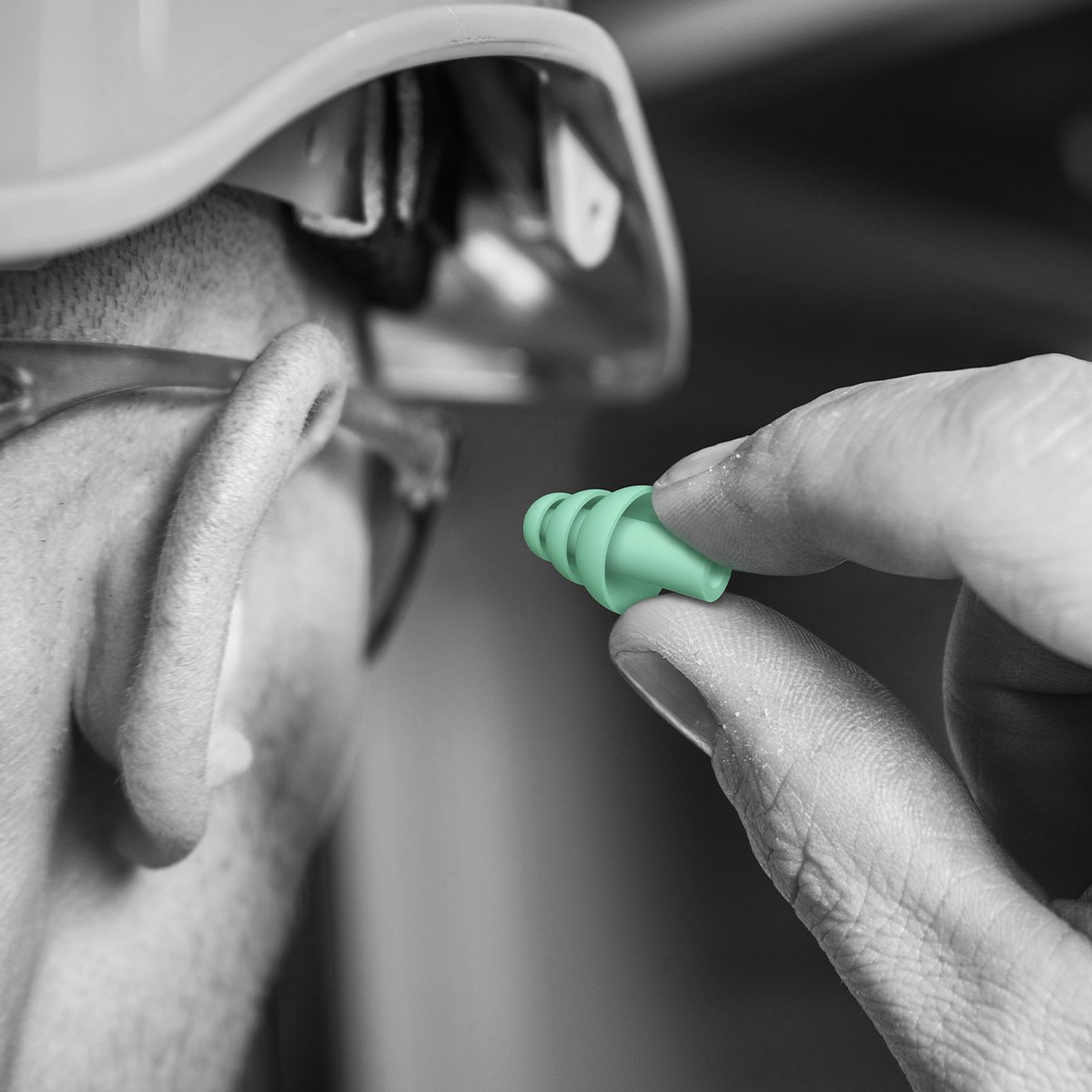
Hearing damage begins at 85 decibels (dB) with prolonged exposure. At that level, your inner ear’s hair cells start to experience stress, and repeated exposure without protection leads to permanent hearing loss over time. Louder sounds cause damage faster: 100 dB can cause damage in under 15 minutes, and anything above 120 dB can cause immediate harm. Below, we unpack the most common questions about how loud is too loud and what you can actually do about it.
How long can you be exposed to loud noise before damage occurs?
The safe exposure limit at 85 dB is about 8 hours. For every 3 dB increase in volume, the safe exposure time is cut in half. At 88 dB, you have 4 hours. At 91 dB, just 2 hours. At 100 dB, damage can begin in as little as 15 minutes, and at 110 dB or above, even a few minutes of unprotected exposure puts your hearing at risk.
This relationship between volume and time is known as the equal energy rule, and it is the basis for occupational noise standards set by organizations like OSHA and NIOSH. The key takeaway: it is not just about how loud something is, but how long you are exposed to it. A moderately loud environment over an extended shift can be just as damaging as a brief blast of extreme noise.
The damage accumulates silently. You may not notice any hearing loss immediately after exposure, but repeated incidents add up over months and years. By the time most people notice a problem, significant and irreversible damage has already occurred.
What sounds in everyday life reach dangerous decibel levels?
Many common sounds routinely exceed the 85 dB threshold where hearing damage begins. Traffic noise on a busy street typically sits around 85 dB. Power tools, lawnmowers, and motorcycles often reach 90 to 100 dB. Live music venues and concerts frequently push past 110 dB, and some nightclubs and stadium events have been measured above 120 dB.
Here are some common sound sources and their approximate decibel levels:
- Normal conversation: 60 dB (safe)
- Busy city traffic: 80 to 85 dB (approaching the threshold)
- Lawnmower or power drill: 90 to 100 dB (dangerous with prolonged exposure)
- Motorcycle engine at speed: 95 to 105 dB (especially with wind noise added)
- Live concert or club: 100 to 115 dB (damage can begin within minutes)
- Jet engine at close range: 140 dB (immediate pain and damage)
What surprises many people is how ordinary situations can cross the danger line. A commute on a loud subway, a shift in a busy kitchen, or an evening at a sports bar can all expose you to noise levels that add up over time. In the US, there is no federal regulation limiting noise levels at concert venues or clubs, meaning attendees are regularly exposed to levels that would be illegal in many workplace settings.
What is noise-induced hearing loss and can it be reversed?
Noise-induced hearing loss (NIHL) is permanent hearing damage caused by exposure to loud sounds. It occurs when sound waves are strong enough to damage or destroy the tiny hair cells inside the cochlea, the spiral-shaped organ in your inner ear responsible for converting sound vibrations into signals your brain can interpret. Once those hair cells are gone, they do not grow back.
In most cases, noise-induced hearing loss cannot be reversed. Unlike a temporary threshold shift, where hearing feels muffled after a loud event but recovers within hours or days, permanent NIHL represents actual physical destruction of sensory cells. Hearing aids and cochlear implants can help manage the condition, but they do not restore natural hearing.
There is one partial exception worth knowing: research into regenerative medicine is exploring ways to stimulate hair cell regrowth, and some early-stage treatments have shown promise. However, as of 2026, no clinically approved treatment exists that reverses established noise-induced hearing loss. Prevention remains the only reliable approach.
What’s the difference between SNR, NRR, and dB ratings on earplugs?
SNR (Single Number Rating) and NRR (Noise Reduction Rating) are both measurements of how much noise an earplug reduces, but they use different testing standards. SNR is the European standard, and NRR is the American standard. A higher number means greater noise reduction. The dB rating on packaging typically refers to one of these two figures, depending on the market.
Here is how they differ in practice:
- NRR (US standard): Tested under ANSI S3.19. To estimate real-world protection, OSHA recommends dividing the NRR by two, then subtracting it from the ambient noise level. An NRR of 30 dB provides roughly 15 dB of real-world protection.
- SNR (EU standard): Tested under EN 352-2. Generally considered a closer reflection of real-world performance. An SNR of 23 dB is a meaningful level of protection for most industrial and occupational environments.
- dB rating on packaging: This is usually the SNR or NRR figure, depending on the country the product is sold in. It is not the same as the decibel level of the sound being blocked.
When comparing earplugs across markets, check which standard was used. A product certified under both systems, as Shush earplugs are, gives you confidence that the protection has been independently verified for multiple regulatory environments.
When should you wear hearing protection?
You should wear hearing protection any time you expect to be exposed to sounds at or above 85 dB for more than a few minutes. That includes concerts, motorsport events, power tool use, loud commutes, construction sites, and any work environment with heavy machinery. If you need to raise your voice to be heard by someone standing next to you, the environment is likely loud enough to cause damage over time.
A useful rule of thumb: if the noise is uncomfortable or makes your ears ring afterward, you needed protection before you arrived, not after. Ringing in the ears after a loud event, known as tinnitus, is a warning sign that your hair cells have been stressed. Repeated episodes increase the risk of permanent damage.
Wearing protection consistently matters more than wearing it perfectly. Even partial protection during most exposures is significantly better than no protection at all. Build it into your routine the same way you would a seatbelt or sunscreen.
Do high-fidelity earplugs protect against hearing damage as well as foam plugs?
Yes, high-fidelity earplugs can provide equivalent or better real-world hearing protection compared to foam plugs, while preserving sound clarity. Foam plugs often have higher lab-rated NRR scores, but those ratings assume a perfect seal, which rarely happens in practice. High-fidelity earplugs are designed for consistent fit and real-world use, which means their actual protection is often more reliable.
The bigger practical difference is that people actually wear high-fidelity earplugs. Foam plugs muffle and distort sound, which makes many people remove them in environments where they want to stay engaged, like concerts, conversations, or work settings. High-fidelity earplugs use precision acoustic filters to reduce volume evenly across frequencies, so sound remains clear and natural rather than muffled. That means you are far more likely to keep them in.
If you work in a high-noise environment and need certified occupational protection, our Shush Worker earplugs are independently certified to SNR 23 dB under EU, US, Canadian, and Australian standards. The ceramic filter technology preserves natural sound quality so you can still communicate with colleagues without removing them, making consistent protection far more practical across a full shift. Made from durable synthetic rubber, they are built for daily use and last considerably longer than foam or standard silicone alternatives.
Frequently Asked Questions
How do I know if my earbuds or headphones are loud enough to cause damage?
A simple test is the arm’s length rule: if someone standing about a foot away from you can hear audio coming from your headphones, the volume is likely above 85 dB. Most smartphones now include built-in volume warnings or weekly listening reports that flag unsafe levels, so enabling those notifications is a smart first step. As a general guideline, keeping headphone volume at or below 60% of maximum and limiting listening sessions to under an hour at a time significantly reduces your risk of noise-induced hearing loss.
Can I use earplugs at concerts without missing out on the music experience?
Absolutely — and in many cases, high-fidelity earplugs actually improve the concert experience. At extremely loud venues, distortion from excessive volume can muddy the mix, and reducing that volume with a flat-response earplug lets you hear instruments and vocals more clearly. Musicians themselves routinely wear custom in-ear monitors or high-fidelity earplugs on stage for exactly this reason. The key is to choose earplugs with acoustic filters designed for music, not foam plugs that muffle and distort the sound.
What are the early warning signs that my hearing may already be damaged?
The most common early indicators are tinnitus (a ringing, buzzing, or hissing sound in the ears, especially after loud exposure), difficulty understanding speech in noisy environments, and a sense that voices sound muffled even when the volume seems adequate. You might also notice that you frequently need to ask people to repeat themselves or that you rely more on reading lips in conversation. If any of these symptoms are recurring, it is worth scheduling a hearing evaluation with an audiologist, since early intervention can help slow further progression even if existing damage cannot be reversed.
How do I correctly insert foam earplugs to get the protection they're rated for?
Most people underestimate how far a foam earplug needs to be inserted to achieve its rated NRR. The correct technique is to roll the earplug into a tight, thin cylinder, reach over your head with your opposite hand to pull your ear upward and outward to straighten the ear canal, then insert the compressed plug deeply and hold it in place for 20 to 30 seconds while it expands. A properly inserted foam earplug should sit flush with or slightly inside the ear canal opening, not protruding outward. Skipping any of these steps can reduce effective noise reduction by as much as 50%.
Is it safe to wear earplugs every day, and can regular use affect your hearing over time?
Daily earplug use is safe for the vast majority of people and carries no risk of hearing damage on its own. The main considerations for regular users are hygiene and ear canal health: reusable earplugs should be cleaned regularly to prevent bacterial buildup, and you should avoid wearing any earplug if you have an ear infection or significant earwax impaction. If you notice irritation, itching, or a feeling of fullness that persists after removal, consult a doctor to rule out an underlying issue. Otherwise, consistent daily use in noisy environments is one of the most effective long-term strategies for preserving your hearing.
What's the best way to protect my hearing at work if my employer doesn't provide protection?
In the United States, OSHA requires employers to provide hearing protection at no cost to workers when noise levels reach 90 dB as an 8-hour time-weighted average, and to implement a hearing conservation program at 85 dB. If your employer is not meeting these obligations, you can file a confidential complaint with OSHA at osha.gov. In the meantime, investing in your own certified earplugs — particularly reusable high-fidelity options rated for occupational use — is a practical and affordable way to protect yourself regardless of workplace policy. Documenting your noise exposure concerns in writing to a supervisor also creates a record if you need to escalate the issue.
Can children and teenagers use the same earplugs as adults, or do they need different protection?
Children and teenagers generally need smaller-sized earplugs to achieve a proper fit, since their ear canals are narrower than those of most adults. Using adult-sized foam or silicone plugs on a child often results in a poor seal and significantly reduced protection. Many manufacturers offer youth or small-fit options, and custom-molded earplugs are also available through audiologists for children who need regular protection, such as young musicians or kids in noisy sports environments. Importantly, children’s hearing is just as vulnerable to noise damage as adults’ — and arguably more so, since they have more years of cumulative exposure ahead of them.
Related Articles
- What are the best gifts for someone who loves going out?
- What are some practical Christmas gifts people will actually use?
- What are some unique Saint Nicholas (Sinterklaas) gifts for adults?
- What earplugs are best for occasional power tool use?
- How do you get workers to actually wear earplugs?
- Are reusable earplugs more cost-effective than disposables for teams?
- Are reusable concert earplugs better than disposable foam ones?
- How do you use earplugs for festivals correctly?
- How do musicians on stage avoid hearing damage during live shows?
- What decibel reduction do you really need for music sound protection?
- Can earplugs for music protection reduce listening fatigue during long shows?
- What should you look for when buying earplugs for music sound protection in 2026?
- Are there earplugs that reduce volume without distorting the music?
- Do earplugs for EDM events block the bass frequencies you came to feel?
- What is the safest way to protect your hearing at outdoor stadium concerts?